Whether you’re a power saver or just getting started, this popular challenge helps build and reinforce sustainable savings habits. By routinely saving a dedicated amount of money each week, you can sock away an extra $1,000+ in just one year with minimal effort.
Sound good? Challenge accepted!
The Challenge
In its standard form, the amount saved each week of the challenge corresponds to the number of weeks completed:
$1 at the end of week #1
$2 at the end of week #2
all the way to $52 at the end of week #52
At the end of 52 weeks, this equates to a total of $1,378!
If you’re already starting with a tight budget and are wondering where the extra savings will come from, there are two main options: 1) Reduce existing spending. Find a way to cut costs from an existing spending category and reallocate towards savings. 2) Increase income. Earn additional money through odd jobs, selling unused items or by allocating money from a bonus or raise.
I completed my first 52 Week Challenge in 2021. Here are some tips to make your challenge a smashing success:
- Grab an accountability partner! For this challenge, I teamed up with a friend to compare budgets and track savings progress throughout the year. This was helpful in keeping each other focused. Social Media can also be a good accountability tool, even if just to reflect on your own progress. Each week I posted my savings envelope on Instagram. Knowing I wanted to continue sharing the posts weekly (for all 12 of my loyal followers), helped to maintain consistency and motivation.
- Embrace modifications! If you’re starting on January 1st, $1 at that time of the year seems simple. This challenge will start to heat up in November and December. Right around the holidays, $40+ per week may not be as manageable. It’s ok to customize the challenge to meet your individual goals.
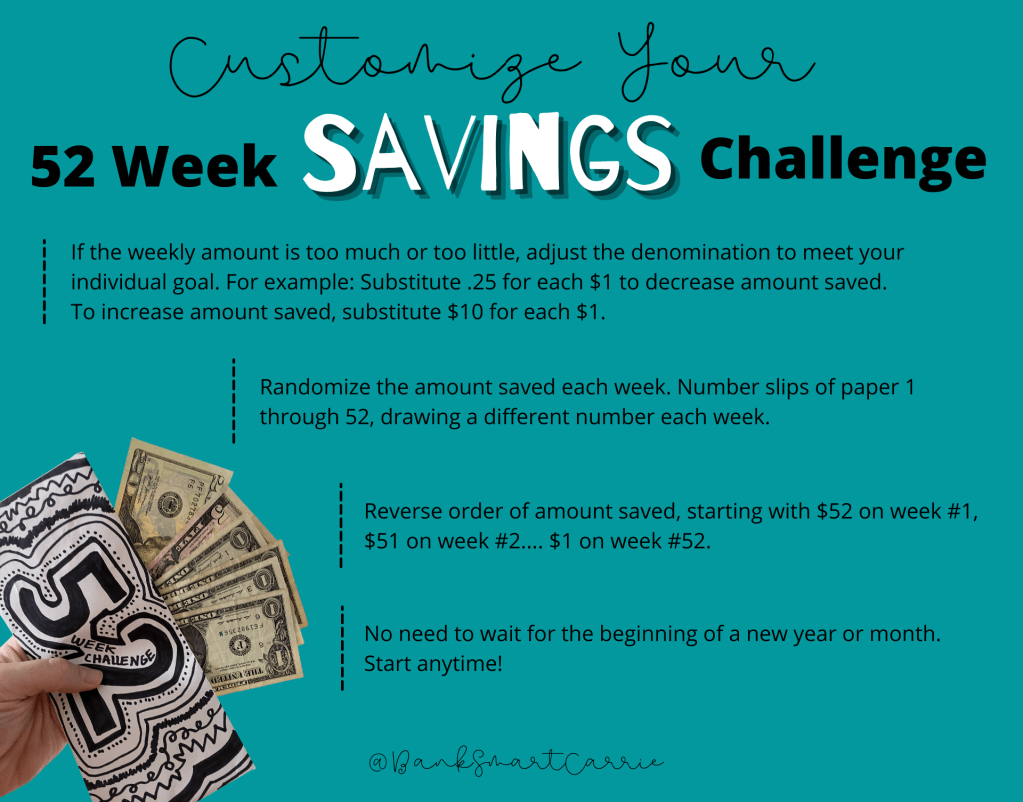
- Assign a goal! At the end of the 52 weeks, your money will need a job. What are you savings towards? Some examples include: pay down debt, add to emergency savings or use for specific purchase. Not planning ahead could result in losing focus or falling victim to an impulse purchase to “treat yourself” for being so disciplined all year.
- Virtual or cold hard cash? For this challenge, I chose to build my savings in cash. It helped make the act of saving more tangible and allowed me to reflect on my progress weekly. If saving cash is too tempting to spend, electronically transferring to a separate savings account may be a more secure alternative. Consider what will work best for your savings style.
If you wish you had an extra $1,378 — The best time to start savings was 52 weeks ago. The second best time is now. Let’s get saving!